It's Day #13 of the
Fabric Printing at Home Blog Tour...it could be your lucky day (just had to say that since it's also Friday the 13th!)! Today the Tour heads over to visit
Terri Stegmiller's blog. Terri loves to create artwork featuring birds, flowers, cats and girls. She also has a line of stencil and thermofax designs.
Terri is a mixed-media artist and designer from North
Dakota, USA. She enjoys creating art quilts that feature layers of design,
color and whimsy. Her favorite quilt subjects include girls, cats, flowers and
birds. Terri also enjoys creating her own fabrics with original designs and has
a line of stencils available through StencilGirl Products (
stencilgirlproducts.com).
Terri's work has appeared in several books and publications and her quilts have
appeared in several international exhibits. You can see more of Terri's work on
the Internet at
www.terristegmiller.com
and
stegart.blogspot.com
Be sure to stop by
Terri's blog today and leave a comment for a chance to win a copy of
Fabric Printing at Home. Terri also has three gorgeous hand-printed fabrics that she'll be giving away to a second lucky winner!
Reading Texture
I've been contemplating what we "read" as texture when looking at a multi-layered (painted/printed) piece of fabric. I define texture as an overall
background effect that sets off the other more dominant elements in the design. Texture can be "obvious" for example, when printing with a block covered with lentils (see
Lynda Heines blog post or
Texture Squared pp.34-43 in
Fabric Printing at Home) or rolling an ear of corn across the fabric (see
Lynn Krawczyk's blog post or
Creating Background Textures with Vegetables pp.50-53 in
Fabric Printing at Home). A combination of repetition of shapes and the small scale of the individual elements contribute to us viewing these prints as texture.
But can other types of blocks "read" as texture and if so, what causes us to see them as texture? Here are some thoughts (and some fabric samples!).
Scale: The typical texture block often has small-scale elements that when printed give an overall textural effect. Larger designs can imitate this small-scale feel if the design is broken up or comprised of a number of smaller elements.
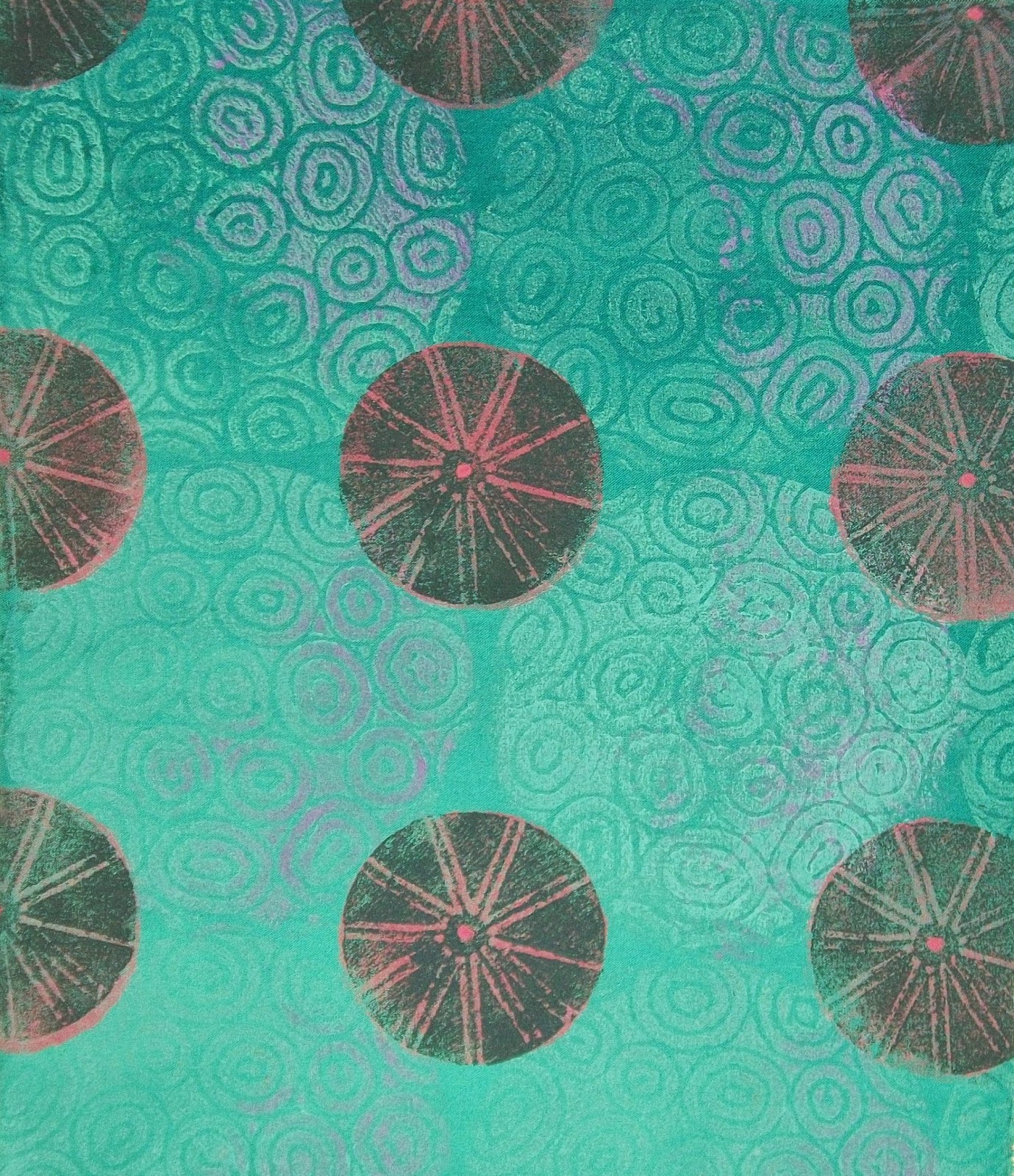 |
| Fabric printed with incised foam block. The concentric circle designs in the large round foam block give an overall effect that "reads" as texture. |
Color blending: If the printed design is the same color as the background fabric or slightly lighter, darker, warmer or cooler than the background color, it will blend and "read" as texture.
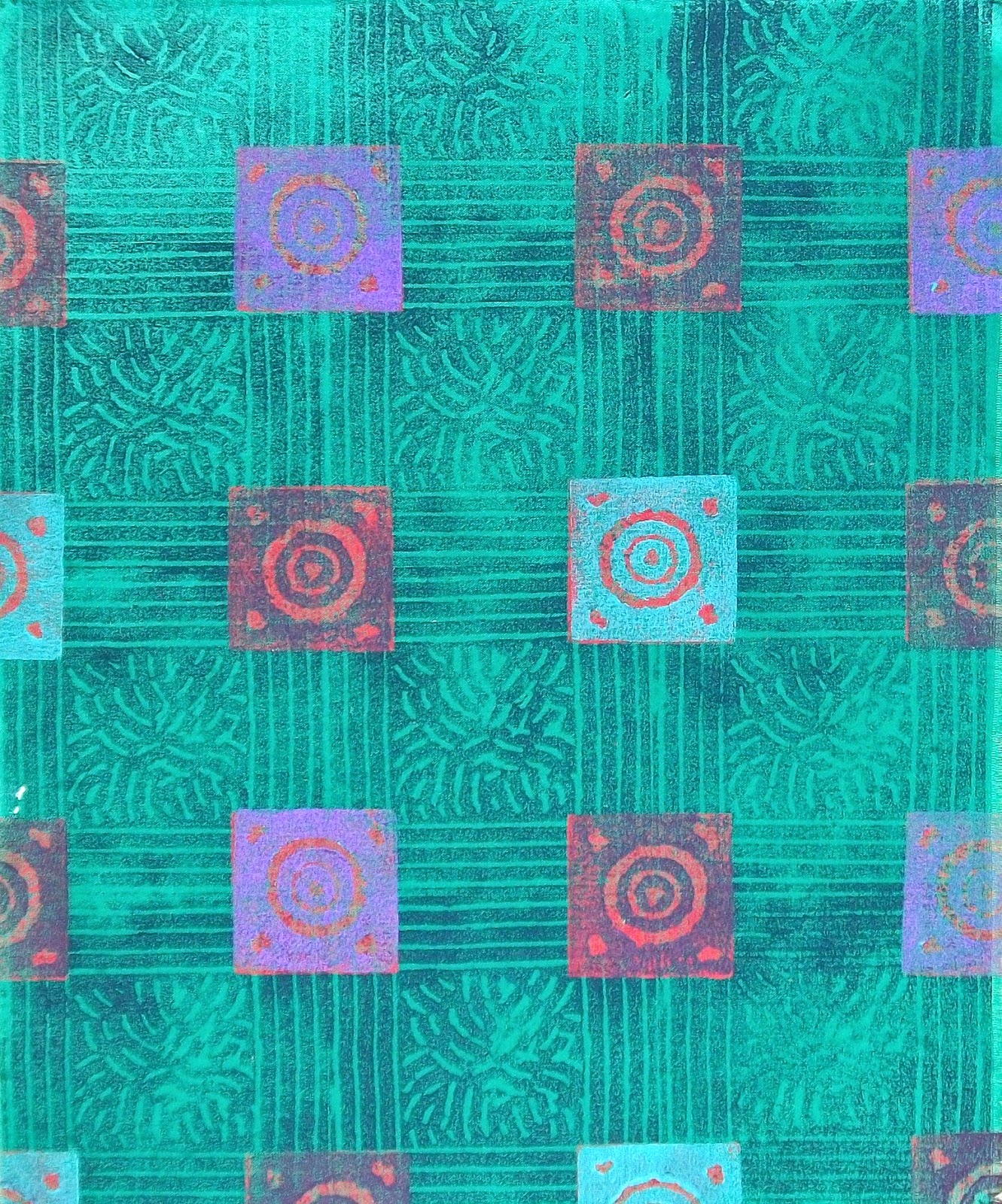 |
| Fabric printed with incised foam blocks. The larger block is a slightly darker green than the color of the background fabric and "reads" as a texture. |
Color contrast: If the focal/dominant elements of the fabric design strongly contrast with the background print, the background print will read as a texture.
 |
| Fabric printed with incised foam blocks. The black focal prints contrast sharply with the pale blue prints of the larger block. The block printed in the pale blue "reads" as a texture in this piece. |
Repetition: If a print is repeated across a piece of fabric, it can often "read" as texture.
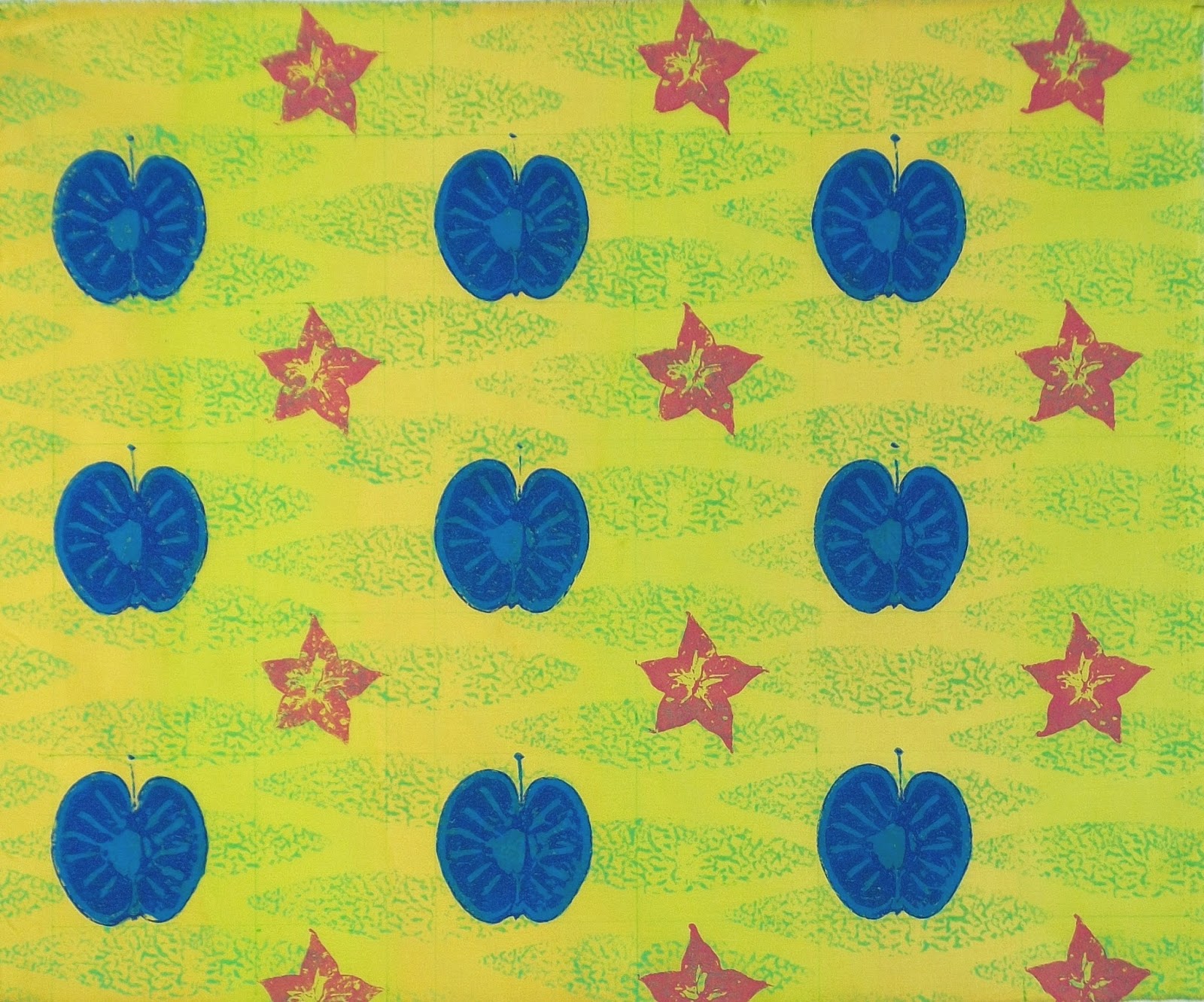 |
| Fabric printed with fruit. The repeating prints with cantaloupe rind "read" as texture. |
Overlapping prints: Print designs or parts of designs that overlap can appear as texture (see
Cheryl Sleboda's blog post about printing with a carrot).
 |
| Fabric printed with a string block. Overlapping prints using a block wrapped with string "read" as texture. |
Of course, most of the time, the qualities that make a print appear as a background texture don't appear singly. For example, color contrast and color blending can appear in the same piece of fabric.
How do you use texture in your work? Do you have a favorite method/technique for bringing texture into your work (printing, stitching, beading...?)? How does the addition of texture enhance your work?
Learn about incised foam designs in Chapter 5:
Recycled and Repurposed pp. 90-91
Learn about printing with fruit in Chapter 3:
Beyond the Potato Print p. 57.
Learn about printing with string blocks in Chapter 2:
Kitchen Textures and Found Object Printing pp. 36-37. All in
Fabric Printing at Home!
Today's giveaway is one yard of Kona Prepared for Dyeing Fabric. Leave a comment for
a chance to win. I will choose a winner at 11:00 PM Eastern USA time.
Check tomorrow's post to see if you are the winner. Your comment also
enters you in the final drawing at noon on February 15 for a free copy of Fabric Printing at Home: Quick and Easy Fabric Design Using Fresh Produce and Found Objects.
And now for the winner of yesterday's giveaway (one yd of Kona PFD)...congratulations to Marcia Coling! Please email me with your contact information (threadborn@cox.net) so I can send off your prize.
Tomorrow is the last day of the tour. Our final stop is Jackie Lams blog. Jackie is an amazing mixed media and graphic artist. She finds much inspiration from her growing family (yay Baby Q.!) Find out more about her in
tomorrow's post.
Be sure to visit all the stops on the Tour. Please note, I've added the deadlines to enter the giveaways at each stop:
February 2 (winner will be chosen on Feb 14): Lisa Chin
February 3 (winner will be chosen noon Feb 15-book and stencils!): Lynn Krawczyk
February 4 (winner will be chosen end of Feb 13): Jane Davila
February 5 (winner will be chosen on Feb 14):
Carol R. Eaton
February 6 (winner will be chosen end of Feb 13- 2 book copies!):
Judy Gula
February 8 (winner will be chosen on Feb 15):
Teri Lucas
February 11 (winner will be chosen on Feb 14- 2 book copies!):
Lynda Heines
February 13 (winner will be chosen on Feb 15- book and fabric!):
Terri Stegmiller